

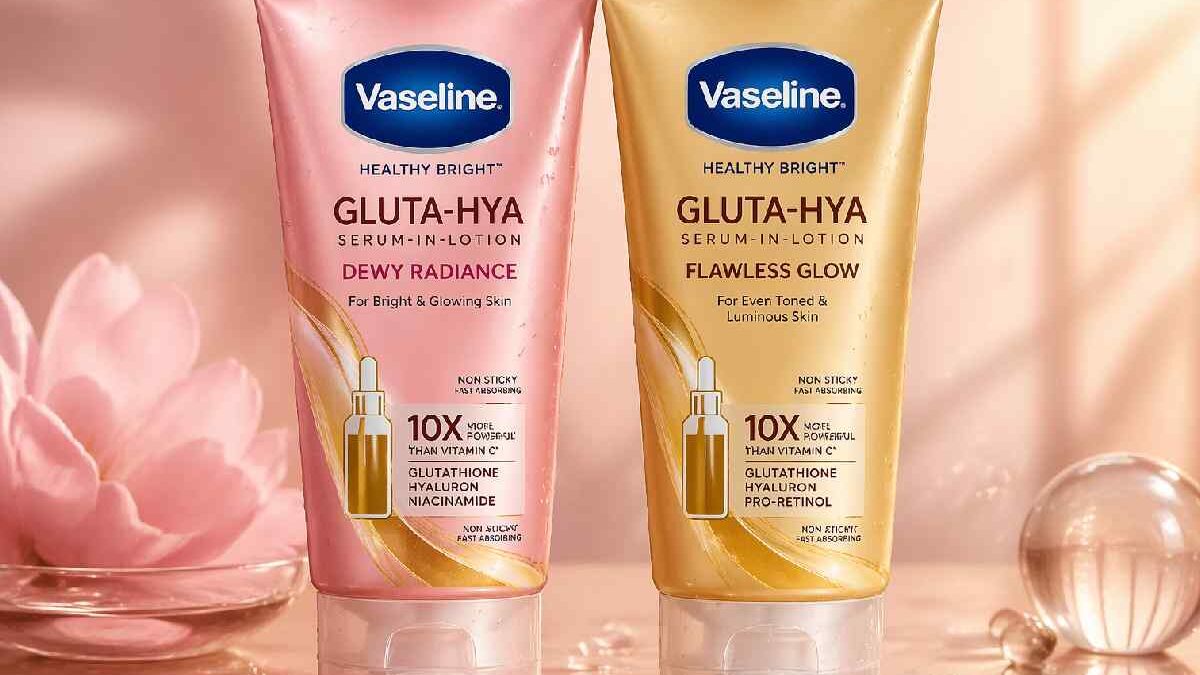
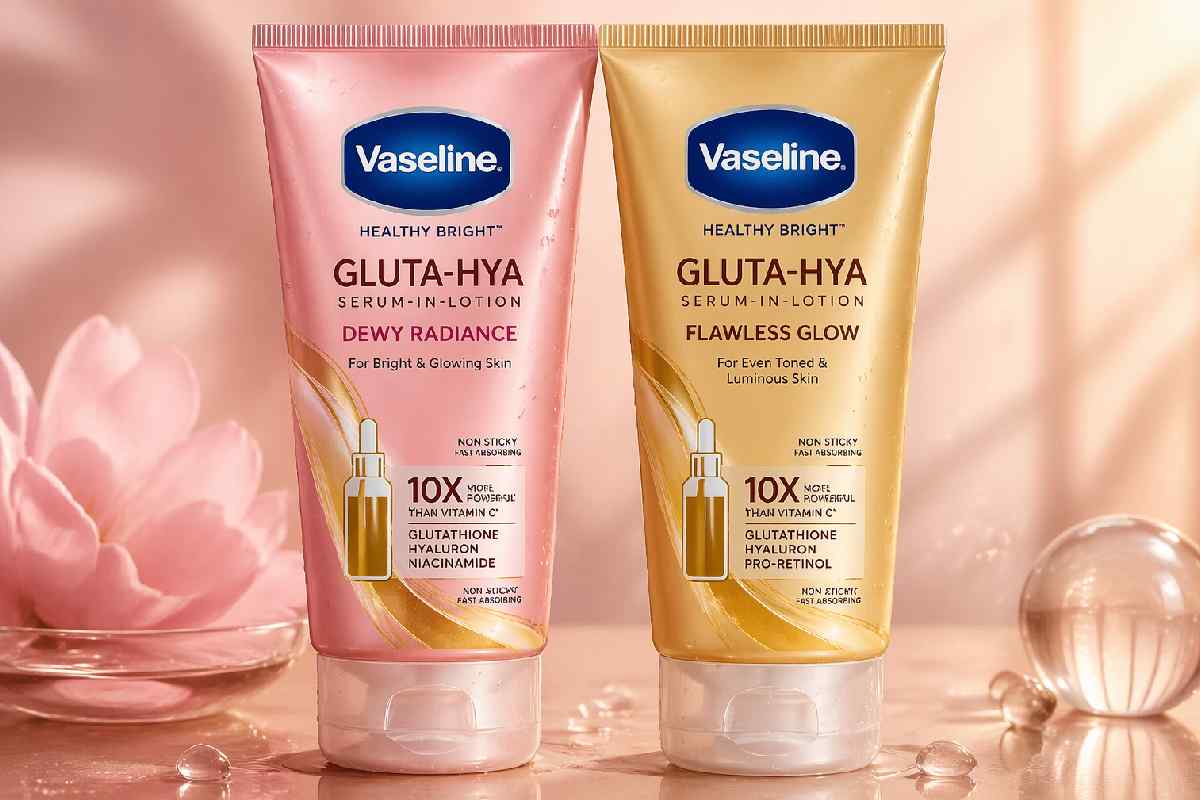
That pink-and-gold tube. You’ve seen it everywhere by now — Instagram reels, Nykaa sale banners, your cousin’s bathroom shelf. Vaseline Gluta-Hya went from “never heard of it” to “sold out on Amazon” in about six months flat.
And now for the things that no one will tell you about these products. For example, what is the effect of glutathione on your skin once applied? Is there any truth to the statement about it being “ten times stronger” than vitamin C? Lastly, can you use a body lotion on your face without breaking out?
The information in this guide comes from analysis of ingredients, dermatological sources, and actual reviews from users. It is not an advertisement for the product but rather an honest evaluation of its strengths and weaknesses.
Table of Contents
Quick Summary Before We Get Into It
- What it is -> Vaseline‘s hybrid serum/in-lotion containing glutathione, hyaluronic acid, a niacinamide or pro-retinol [based on which version you pick] you choose. Light-weight. Non-sticky. Dries mega quick.
- Best for → Oily to normal skin. Indian summers. People who can’t stand greasy body lotions but still want some brightening action.
- Dewy Radiance or Flawless Glow? → Radiance for hydration and glow (niacinamide). Glow for dark spots and uneven tone (pro-retinol). Same price either way.
- Face use? → Technically possible. But it’s a body lotion — fragrance is higher, pore-clogging risk is real. Patch test or just get a face moisturizer.
- Side effects → Mostly fragrance sensitivity. And it’s not a sunscreen, even though people keep assuming it is.
What Is Vaseline Gluta-Hya, Really?
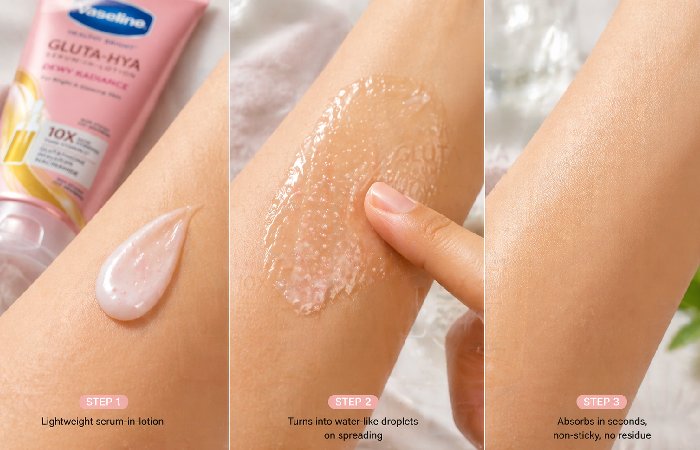
Skip the marketing speak for a second. At its core, this is a body lotion. A good one — but still a body lotion.
What makes it different from the Vaseline Intensive Care your mom probably used? The format. Vaseline calls it a “serum-in-lotion,” and that description is actually honest. You squeeze it out, spread it across your arm, and the texture kind of — bursts. It turns into these water-like droplets that sink in within seconds. No residue. No sticky film. No waiting ten minutes before you can put clothes on.
The name already gives you the 2 main ingredients – Gluta-Hya. Gluta = glutathione (an antioxidant supposedly helping brighten skin). Hya = hyaluronic acid (the moisture magnet you’ve probably heard about a hundred times by now). Each variant then adds its own secondary active on top of that base.
Launched first in Southeast Asia. Hit India around 2023. It has quickly become one of Unilever’s more heavily marketed and widely stocked body care ranges in India.
So What’s GlutaGlow Technology?
You’ll see this phrase on every tube. “GlutaGlow technology — 10x more powerful than Vitamin C.”
Sounds impressive. Worth unpacking, though.
That “10x” comparison is about antioxidant capacity. Glutathione can neutralize certain types of free radicals more efficiently than L-ascorbic acid (the standard form of Vitamin C used in serums). Fair enough — that’s a real biochemical property.
But does that mean this lotion brightens your skin 10 times faster than a Vitamin C serum? No. Not even close. The concentration is different, the delivery system is different, and skin penetration works differently for a body lotion versus a targeted facial treatment. The marketing claim is technically defensible. The way most people interpret it? That part’s misleading.
What you’ll actually experience: gradual brightening over 3–4 weeks of daily use. An immediate hydration glow from day one (that’s the hyaluronic acid, not the glutathione). And a texture that genuinely feels better than any other body lotion in this price range.
Reasonable expectations. Just not miraculous ones.
The Ingredients — What Each One Actually Does to Your Skin
Every product listing just throws out ingredient names. “Contains glutathione! Niacinamide! Hyaluronic acid!” Cool. But what do they do once they’re on your skin? And how honest should you be about the science behind each one?
Pretty honest, it turns out.
Glutathione — Your Skin’s Own Brightening Molecule
This is already produced by your body. Glutathione is a very common tripeptide, consisting of three amino acids (glysine, cysteine, glutamation) linked together. It occurs in nearly every cell you have as an antioxidant and detoxifier.
For skin specifically, it targets melanin production through two routes:
- Approach one: inhibitors could function to stop tyrosinase, which is the enzyme involved in catalysing the formation of melanin. When tyrosinase inhibitors function, it means that pigment production is reduced.
- Route two (and this one’s interesting): It can shift your skin’s melanin production toward pheomelanin — a lighter, more yellowish pigment — instead of eumelanin, which is the darker brown-black kind. So it’s not just reducing melanin. It’s changing the type of melanin your skin produces.
Almost all of the more impressive findings in published research (PubMed, National Library of Medicine) would be using oral glutathione and not a lotion. The real problem with topical glutathione is would it be absorbed enough through the skin barrier to actually reach the melanocytes.
Does that mean it’s useless in a lotion? No. It means the effect is modest and cumulative. You’re not getting clinical-grade skin lightening from a ₹300 tube. You’re getting a slow, gentle push toward brighter-looking skin — especially if you’re applying daily and combining it with the other actives in the formula.
Hyaluronic Acid — The Reason Your Skin Looks Better Immediately
HA doesn’t brighten anything. Let’s get that out of the way first.
Hyaluronic acid is in a group called humectants that pulled moisture from the air and deeper in the skin and up to the surface. Hyaluronic acid holds one thousandth the weight of itself in water, clarifies the Cleveland Clinic in the hyaluronic acid facts.
When your skin is properly hydrated, the surface smooths out. Light bounces off more evenly. That ashy, flaky, tired look disappears. So the “instant glow” people notice after their first application of Vaseline Gluta-Hya? That’s mostly the HA. Not the glutathione. The glutathione needs weeks.
There’s a practical detail here that matters, though. HA works by pulling water toward your skin. If you apply it on completely dry skin in a low-humidity environment — say, an air-conditioned office in January — it can actually draw moisture out of your deeper skin layers instead. Always apply on damp skin. Right after a shower is ideal.
Niacinamide — Dewy Radiance’s Secret Weapon
This is the ingredient that differentiates the Dewy Radiance range from the rest. Niacinamide (Vitamin B3) has possibly more online published available evidence on it than any other OTC skincare ingredient.
It gets really interesting now. The mechanism through which glutathione and niacinamide lighten skin is completely distinct from each other. Glutathione has its effect on the upstream melanin production within the cell, while niacinamide on the downstream transfer of melanin in between the cells.
So in the Dewy Radiance formula, you’ve got a one-two approach. Glutathione slowing down the melanin factory. Niacinamide intercepting the delivery trucks. That combination — working at two different stages of the same process — is genuinely smart formulation.
And niacinamide does more than brighten. It calms redness, decreases oil (excellent for those who are oily in humidity), and improves your skin barrier. One of the most versatile ingredients we have ever seen!
Pro-Retinol — Flawless Glow’s Angle
The Flawless Glow variant swaps niacinamide for pro-retinol. Different strategy entirely.
Pro-retinol is a gentler relative of retinol — your skin converts it into retinoic acid after application. Its job here isn’t to block pigment transfer. It’s to speed up cell turnover. Dead, pigmented skin cells shed faster. The replacement of these cells with new ones is what creates this smoothness and evenness of the skin.
It’s mild compared to prescription retinoids. You’re unlikely to see the peeling, flaking, and irritation that come with proper retinol serums. But the trade-off is obvious — gentler means slower results.
One thing that matters a lot with this variant: pro-retinol increases your skin’s sensitivity to UV radiation. If you’re using Flawless Glow in the morning and stepping outside? Sunscreen. Every single time.
Dewy Radiance vs. Flawless Glow — The Actual Differences
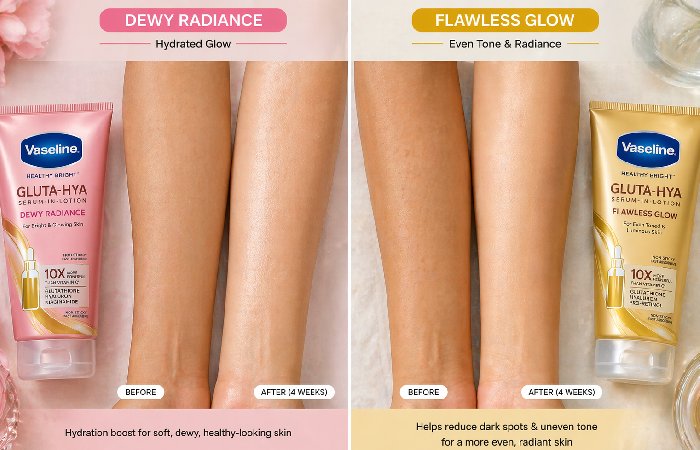
People overthink this. Both variants share the same glutathione + hyaluronic acid + serum-burst base. The split comes down to one secondary ingredient and what you want it to do.
| Feature | Dewy Radiance | Flawless Glow |
|---|---|---|
| Secondary Active | Niacinamide | Pro-Retinol |
| What It Targets | Dull skin, dehydration, uneven radiance | Dark spots, tan marks, rough texture |
| Texture Feel | A touch lighter | Slightly richer |
| Sun Sensitivity | Low — niacinamide doesn’t increase photosensitivity | Higher — pro-retinol makes skin more UV-reactive |
| UV Filters | None in standard Indian variants | Some versions include them (check label) |
| Best Time to Apply | Morning or night — doesn’t matter | Night preferred. Or morning with sunscreen on top |
| Price (200ml, India) | ₹280–420 | ₹280–420 |
| Best Skin Type Match | Oily-normal, dehydration-prone | Normal-dry, pigmentation-prone |
| Aspect | Dewy Radiance (Pink) | Flawless Glow (Gold) |
|---|---|---|
| Key added active | Niacinamide | Pro-retinol |
| Main skin goal | Hydration boost and fresher-looking radiance | Dark spots, tan marks and rougher texture |
| Texture feel | Slightly lighter on skin | Feels a bit richer but still fast-absorbing |
| Sun sensitivity | Does not increase UV reactivity | Can make skin more UV-reactive, especially without sunscreen |
| Typical use time | Works well morning or night | Better at night, or daytime only with proper sunscreen on top |
| Safer for sensitivity | Generally better suited to easily-irritated bodies | Mild overall, but more likely to bother very reactive or thin skin |
Which One Matches Your Problem?
“My arms and legs look dull and ashy, especially after being out in the heat.” Dewy Radiance. The niacinamide + HA combination was designed for exactly this — hydration-based radiance recovery.
“I’ve got stubborn tan lines and dark patches that won’t fade.” Flawless Glow. Pro-retinol’s exfoliation will push those pigmented cells out faster.
“I just need something light. The sticky-lotion situation is my main problem.” Grab either one. Honestly. The serum-burst texture is identical across both variants. Both absorb in seconds.
“My skin reacts to new products easily.” Dewy Radiance. Niacinamide is widely tolerated — even by sensitive skin types. Pro-retinol is relatively gentle, although it is associated with a slightly increased risk of initial irritation.
If you want a quick way to decide without overthinking the details, here’s the short version:
- Select Dewy Radiance if your main concerns are daily softness, a lightweight feel and natural luminous glow.
- Choose Flawless Glow if your priority is less figure, more flaws, like tan lines, uneven patches and slightly rough skin on arms and legs.
- If your skin or nose have been irritated by strong scent in the past, either avoid or test on a small size first.
Beyond the Two Main Ones
Worth knowing the rest of the lineup exists:
- Overnight Radiance Repair — Night formula with amino-peptide complex. For people who want a dedicated PM product. Not widely available in India yet.
- Pro-Age Restore — Anti-aging variant with collagen-supporting ingredients. Select markets only.
- SPF 50 versions — These exist in some international markets. In India, availability is inconsistent, so never assume your tube has SPF unless it is clearly printed on the front label.
- Lip balm — Gluta-Hya branded lip care shows up in some markets. Rare in Indian retail as of early 2026.
Can You Put This on Your Face? — The Honest Answer
Everyone asks this. And the answer isn’t simple.
The actives in this formula — glutathione, niacinamide, hyaluronic acid — are used in facial products all the time. On their own, they’re perfectly face-safe. That isn’t the problem.
The problem is everything else in the bottle.
Why Body Lotions and Face Moisturizers Aren’t the Same Thing
Three differences that actually matter:
Fragrance. Body lotions carry more of it. VVaseline Gluta-hya has parfum plus some more specific fragrance mixes (citronellol, limonene, etc.). Your own body skin- thick, hard, non-sensitive- accepts it without complaint. Facial skin is thinner. More nerve endings. More prone to contact dermatitis from fragrance ingredients. If you’ve ever had a red, itchy reaction to a scented product on your face, this is the reason.
Pore-clogging risk. Most face moisturisers undergo non-comedogenic testing to determine whether the formula blocks pores and causes breakouts. Body lotions? Usually don’t. The emollients and texture agents designed for body skin can be too occlusive for facial pores. Especially around the nose, chin, and forehead where pores are larger and oil production is higher.
Testing scope. Manufacturers test body products on body skin. That sounds obvious, but the implication matters. Safety data, irritation thresholds, absorption rates — all validated for arms, legs, torso. Not for the thinner, more permeable skin on your face.
So Should You Do It Anyway?
But “it worked for someone in an Amazon review” is a very different thing from “it’s been formulated and tested for facial use.” If you want to try it anyway — and plenty of people do — here’s how to reduce your risk:
- Put a thin layer on the inside of your jawline. Not your whole face. Just the jawline.
- Leave it for 48 hours and see if it bumps or itches or looks red or the tingling sensation still remains after a minute or two.
- If nothing happens, try a small patch on one cheek. Another 48 hours.
- Still clear? Then go for it — but monitor for the first week.
And if you have acne-prone skin or a history of sensitivity? Skip this experiment entirely. Plenty of face moisturizers exist in the same ₹200–400 range that are specifically designed, tested, and labeled for your face. Use those instead.
As a simple rule, anyone with frequent breakouts, recurring redness or a history of reacting to scented lotions will be safer keeping this product strictly below the neck.
Side Effects — What Could Go Wrong
Not much, honestly. But “not much” doesn’t mean “nothing.”
The Fragrance Issue
This is the most common complaint. The product smells nice — most people genuinely like the scent. But it contains parfum and individual fragrance allergens (citronellol, limonene are the usual suspects). For the majority of users, this is completely fine.
For people with fragrance sensitivity — and that’s a bigger group than most brands acknowledge — it can trigger redness, mild itching, or low-grade dermatitis that builds over repeated use. The irritation sometimes doesn’t show up immediately. It might take a week of daily application before you notice something feels off.
If you’ve reacted to scented body lotions before, patch test this one first. Or just go fragrance-free. It’s not worth the gamble for a body lotion.
The Sunscreen Confusion
This surprises people. Most Dewy Radiance and Flawless Glow body lotions sold in India — the ones you’ll find on Amazon, Flipkart, Nykaa, Myntra, or at local supermarkets — are not labeled with an SPF value, so you should not treat them as your sunscreen. They’re hydrating body lotions with brightening actives. Not sun protection.
Why is this such a big deal? Because they are both active on pigmentation. And UV exposure is the leading catalyst of melanin production. If you‘re slapping on the Gluta-Hya and accidentally walking into the sun sans SPF, you‘re just negating the brightening effect you‘ve paid for. With the Flawless Glow variant — which contains pro-retinol that increases photosensitivity — you could actually end up with more pigmentation, not less.
Non-negotiable rule: sunscreen goes on top during the day. SPF 30 minimum, broad-spectrum. Every time.
Getting the Most Out of It — Usage Tips That Matter
Not complicated. But a few of these details make a surprisingly big difference.
Apply on damp skin, always. This is the one tip that changes everything. Hyaluronic acid needs available water to work properly. Putting it on wet-from-the-shower skin gives it moisture to grab and pull inward. Putting it on bone-dry skin in a dry room? The HA molecule doesn’t care where the water comes from — it’ll pull from your deeper skin layers instead. Counterproductive.
A little goes further than you think. The serum-burst texture spreads like nothing else. A coin-sized amount covers your entire forearm. People waste product by squeezing out too much.
Daily consistency matters more than amount. The brightening ingredients work cumulatively. Using it heavily three times a week gives you less than using a thin layer every single day. Both the glutathione, and niacinamide (or the pro-retinol) require ongoing exposure to disrupt the trend of melanin production and transfer.
Flawless Glow users: evening application is smarter. Because pro-retinol increases sun sensitivity, using it at night lets the active work without competing against UV exposure. If you do use it in the morning, sunscreen on top is mandatory — not optional.
In very dry weather or air-conditioned rooms, layering a thicker cream over it can help people with naturally dry body skin feel more comfortable.
Price in India and Where to Find It
Standard 200ml tube: ₹280 to ₹420. The exact price jumps around depending on the platform and whatever sale is running that week.
Reduced 70g tubes can be purchased if you‘d like to try it first on a trial basis. Good planning, of course, if you have fragrance allergies.
Where to buy:
- Amazon India widest choice of variants, Subscribe & Save sometimes reduce price further
- Flipkart- best prices if you buy during sale events like bigbillion days.
- Nykaa regular beauty sales (Pink Friday, Hot Pink Sale) drops the price to 250 or less. Might be the finest offer if you set your time right
- Tira Beauty, Myntra — stocked, though selection is sometimes limited
- Offline — DMart, Reliance Smart, most supermarket chains carry it now
For a body lotion with active ingredients like glutathione, niacinamide, and hyaluronic acid, the value proposition here is strong. Standalone serums with these ingredients cost two to three times as much — and you’d need separate products for body versus face use anyway.
Mistakes People Actually Make With This Product
Assuming it has sunscreen. The single most common mistake. Standard Indian variants don’t include SPF. Some international versions do. Check your label. Don’t assume.
Expecting overnight transformation. “Brighter skin from first use” is technically true — but it’s the hyaluronic acid hydration creating that immediate glow, not actual pigmentation change. Real brightening takes 3–4 weeks. Minimum.
Using Flawless Glow in the morning without SPF. Pro-retinol and unprotected sun exposure is a bad combination. You’re making your skin more vulnerable to the exact damage you’re trying to fix.
Slathering it on dry skin. HA needs water. Dry skin in dry air means HA are trying to drag the water from the deeper areas of the skin. Always use on damp skin, or directly after your shower.
Using it as your sole moisturizer in a Delhi winter. This formulation was designed with humidity in mind. The comparatively featherweight feel that‘s ideal during Mumbai‘s monsoon months will be far too light when North India trundles into November and the air becomes arid. Expect to have to pile on a little extra.
Who Gets the Most Out of This — and Who Should Skip It
It works well for:
- Oily to normal skin types who’ve given up on body lotions because everything feels like a grease layer — the serum-burst format genuinely solves this problem
- Anyone whose body skin looks dull, grayish or uneven after having been exposed to the summer sun. In particular the arms, legs, and neck
- Skincare shoppers, on a budget, who are looking for active-ingredient body care without the price tags of a facial serum
- Those living in humid, hot parts of India (Mumbai, Chennai, Kolkata, Goa, Kerala) where none of the heavy creams is bearable for eight months out of twelve
Probably not right for:
- Severely dry skin that flakes or cracks — the lightweight texture just isn’t enough moisture, particularly during winter months. You’ll need a heavier occlusive cream on top, or a different product entirely
- Fragrance-sensitive individuals. The parfum load is noticeable. If scented products have triggered reactions for you before, trust that pattern
- Anyone expecting dramatic, clinical-grade skin lightening. This is a daily body lotion with gentle brightening ingredients — not a prescription depigmenting treatment. Keep expectations proportional to the product category
- Acne-prone facial skin. Stick with products specifically tested for comedogenicity on the face. Please.
The Bottom Line
Vaseline Gluta-Hya earned its popularity for a reason. The serum-burst texture is legitimately impressive for the price — nothing else at ₹300–400 absorbs this fast or feels this light on skin. This ingredients combination (glutathione + HA + niacinamide or pro-retinol) is a valid scientific approach, even if the “10x Vitamin C” marketing line exaggerates on the result it delivers.
Choose Go with Dewy Radiance if dull and dehydrated skin is your only concern. Otherwise choose Flawless Glow if uneven texture, tan lines and dark spots is a problem for you.
But keep two things in perspective. First, this is a body lotion — not a dermatological treatment. It works within the limits of what a daily-use, rinse-and-go body product can do. Second, sunscreen is not optional alongside this product. Ever. The brightening actives need UV protection to do their job properly.
Used daily, on damp skin, with realistic expectations and proper sun protection? It’s one of the better body care products available in India right now.
Frequently Asked Questions
Q: Is Vaseline Gluta-Hya actually good for skin?
A: For body care, yes — it’s well-formulated. The glutathione and niacinamide target pigmentation through different mechanisms, and hyaluronic acid handles hydration without weighing your skin down. Softer texture shows up in a few days. Noticeable tone improvement needs 3–4 weeks of consistent daily use. Don’t expect clinical-grade results from a body lotion, but within its category, it delivers.
Q: Can I put Vaseline Gluta-Hya on my face?
A: The actives are face-safe. The formula wasn’t designed for it. Higher fragrance concentration plus no comedogenicity testing means you’re rolling the dice — especially if your skin breaks out easily or reacts to scented products. Patch test on your jawline for 48 hours first if you’re determined to try. But honestly? There are face moisturizers at the same price point that are specifically built for facial skin. Use those instead.
Q: Is it a daily moisturizer?
A: For bodycare, yes that‘s a good formula. Glutathione and niacinamide work in different ways to address the pigmentation, and Hyaluronic Acid is there to provide moisture without heaviness. During dry winters or if you’re in places like Delhi and Jaipur in January — you’ll probably need something richer layered on top.
Q: What are the side effects?
A: Uncommon for most people. The main risk is fragrance sensitivity — parfum plus specific allergens like citronellol can trigger mild dermatitis or itching in reactive individuals. Not always immediate, either — sometimes takes a week of daily use to surface. The other big one isn’t a side effect, it’s a misunderstanding: this product doesn’t contain SPF (most tubes sold in India at least), so skipping sunscreen while using it can backfire on your brightening goals.
Q: Dewy Radiance or Flawless Glow — which should I buy?
A: Depends entirely on your priority. Dull, dehydrated skin that requires a radiance boost -> Dewy Radiance (niacinamide). Dark spots, stubborn tan, uneven patches -> Flawless Glow (pro-retinol). Same base formula, same price, same texture. The secondary active is the only real difference. If your skin is sensitive, Dewy Radiance is the safer pick — niacinamide plays nicer with reactive skin than retinol derivatives do.
Q: Does Vaseline Gluta-Hya have SPF?
A: Not in the standard Indian bottles. The 200ml Dewy Radiance and Flawless Glow tubes you’ll find on Amazon, Flipkart, and Nykaa don’t include sun protection. SPF 50 variants exist internationally — but they’re rare in Indian retail. Always read the label on your specific tube. And regardless of variant, use a separate sunscreen during the day. Always.
Disclaimer: This article has been written for general informational purposes only. It should not be used for dermatalogic diagnosis, advice, or treatment. Information provided regarding products, contents, and prices can quickly become out-of-date as time marches on; and each person‘s reaction will be unique depending on predisposition, existing conditions, SkinType and how a particular product is used. Always read the label on your own bottle, always patch test ahead of using a product extensively, and consult a QualifiedDermatologist or other qualified physician if you are undergoing treatment, have sensitive or problem skin, or a history of allergies and adverse reactions.
About the Author:
Abdul Rahman, has more than 4 years experience writing about consumer electronics, laptops and IT support solutions in Ireland and the UK. He simplifies complicated repair terms into easy, useful advice so you can be sure of your buying decisions.
Published by: www.health4fitnessblog.com a convenient source of content on business, health, technology and lifestyle that strives for relevance and use rather than sophisticated implementations and complex concepts.