

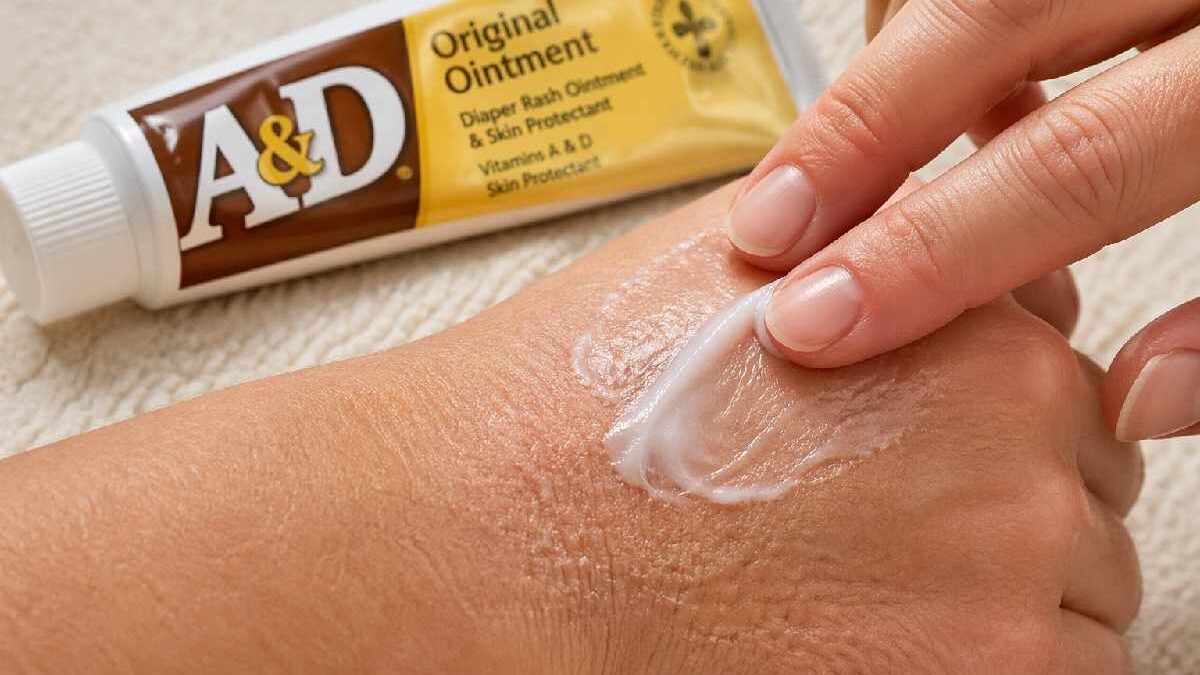
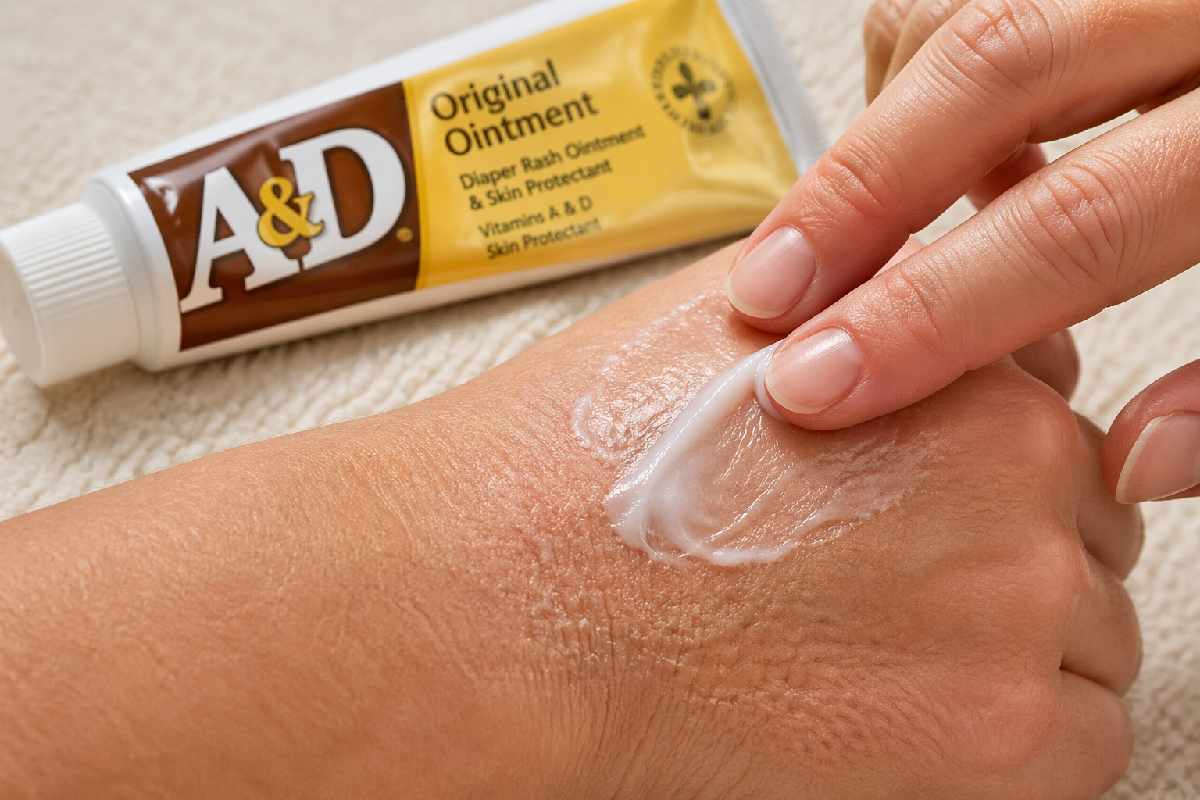
You’ve seen it in the baby aisle. Maybe a tattoo artist mentioned it. Or your hands are cracked from winter weather and someone swore by it. A&D ointment has been sitting quietly in medicine cabinets for over 80 years — and most people still don’t fully know what it does, or when it actually makes sense to use it.
It discusses the complete picture: what you get, what it‘s used for, how you use it properly for every application, when to use another product and that one occasion where you definitely shouldn‘t be getting it out.
Table of Contents
Key Takeaways
- A&D ointment is a skin protectant with petrolatum and lanolin as its active ingredients, plus cod liver oil for vitamins A and D
- It’s primarily used for diaper rash but works well for dry/cracked skin, minor cuts, chapped lips, and tattoo aftercare
- The Original formula differs meaningfully from the Zinc Oxide version — they’re not interchangeable
- It’s FSA/HSA eligible in the USA
- Don’t use it on infected wounds, deep burns, or large body surface areas without medical guidance
What Is A&D Ointment?
A&D ointment is a topical skin protector that can be obtained without prescription. It is made up of petrolatum together with lanolin, which forms a moisture-retaining occlusive layer over damaged skin to minimize the contact with irritants and decrease water loss. The present day ready-packed substances also contain cod liver oil that provides the essential vitamins A and D. It does not treat infection, nor does it do anything to facilitate healing through an antibiotic like mechanism of action. What it does does consistently protect.
That distinction matters. A lot of people reach for A&D thinking it has antiseptic properties. It doesn’t. But for the conditions it was designed to address, the protective barrier is exactly what the skin needs. The full ingredient listing, inactive components included, is documented in the FDA’s official DailyMed drug label for vitamins A&D ointment — a useful reference if you want to verify exactly what’s in the tube you’re holding.
Quick Facts:
| Feature | Detail |
|---|---|
| Active Ingredients | Petrolatum (53.4%), Lanolin (15.5%) |
| Additional Ingredients | Cod liver oil, light mineral oil, microcrystalline wax, paraffin, fragrance |
| Primary Use | Diaper rash prevention and treatment |
| OTC Status | Yes — no prescription required |
| FSA/HSA Eligible | Yes |
| Brand Trust | 80+ years on the market |
What’s Inside A&D Ointment? Ingredients Explained
Three core components do the real work here.
- Petrolatum (53.4%) — the dominant active ingredient — is a refined hydrocarbon mixture that sits on the skin’s surface and physically blocks water loss. It’s one of the most studied occlusive agents in dermatology. The FDA recognizes petrolatum as a safe and effective skin protectant at concentrations between 30% and 100%. At 53.4%, A&D’s formula sits well within that effective range.
- Lanolin (15.5%) is an emollient. It is derived from sheep wool and helps soften and smooth dry, rough skin, complementing the barrier effect of petrolatum. You feel the benefit of it in A&D‘s texture rather than the “hard snow” of just Vaseline: not purely occlusion. Absolutely moisturizing.
- Cod liver oil supplies fat-soluble vitamins A and D. Vitamin A supports skin cell turnover and helps maintain the integrity of the outer skin barrier. Vitamin D plays a role in skin immune function and wound-response modulation. As WebMD’s clinical drug reference for topical vitamin A & D notes, these vitamins work alongside the barrier ingredients rather than functioning as standalone therapeutic agents at the concentrations present in OTC formulas.
Other inactive ingredients such as light mineral oil, microcrystalline wax, paraffin and fragrance help provide texture, consistency and application. The original formulation does however contain a fragrance which may cause a sensitivity or irritant for some people with very sensitive skin.
What Is A&D Ointment Used For?
Most guides would be done here at “diaper rash” or will leave. This is just scratching the surface.
Diaper Rash — The Primary Indication
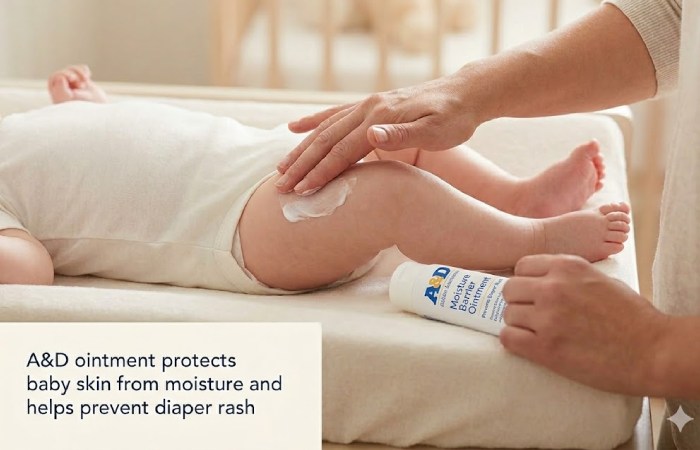
This is what A&D was built for. When a baby’s skin is exposed to prolonged contact with urine or stool, the skin barrier breaks down. Friction accelerates that. The combination of petrolatum and lanolin creates a physical shield between the skin and those irritants at each diaper change.
Apply it liberally with each change — especially at bedtime or during extended periods when the diaper stays on longer. The skin needs a thick enough layer to maintain the barrier; a thin film won’t hold up.
Dry and Cracked Skin — Adults Use This Too
Cracked heels, dry elbows and winter-heated hands all respond well with A&D. The occlusive-plus-emollient approach is decidedly superior to even the best petrolatum product on severely dry skin. The product should be applied liberally overnight, and covered with cotton sox while sleeping to allow it to work its magic. The results are typically quite dramatic within 2 to 3 days of nightly application.
Minor Cuts, Scrapes, and Burns
A&D is effective for minor first-aid use. Its role is specific: it keeps the wound moist, which reduces scabbing and supports faster surface healing. According to the NLM’s DailyMed label for vitamins A&D ointment, the product is indicated for the protection of minor cuts, scrapes, and burns — but it carries no antiseptic or antibacterial action. Clean the wound first, then apply A&D as a protective layer over clean skin.
Chapped Lips
Small quantities of A & D can be used to help prevent chapping, as it can help seal in moisture, however should be used sparingly, and a small amount applied in a thin layer to cleanse, dry lips, preferably at night or just before going out in windy, or very dry weather and should not be used inside the mouth.
Tattoo Aftercare
This one generates more debate than it should. Many tattoo artists still recommend A&D for the first two to three days of healing — specifically because its occlusive barrier keeps the tattooed skin from drying out while it’s most vulnerable. Precise application is crucial. Too much can cause it to feel overwhelming and leave the skin overly damp. For the first 48 to 72 hours, apply a very thin film two to three times daily then ease into a light, unscented skin care, or follow your tattoo artist‘s advice.
Incontinence-Related Skin Irritation in Adults
This use is almost never mentioned — and it’s genuinely useful. Adults managing incontinence often develop perianal irritation from moisture exposure, which is mechanically identical to diaper rash. A&D is appropriate here for the same reason it works in infants: the barrier keeps urine and stool off compromised skin long enough for it to recover.
Eczema and Psoriasis (With a Caveat)
Some eczema sufferers say the emollient–barrier mixture of A&D ointment helped to settle things down during a flare but this application you should always check with a dermatologist first. In some individuals, lanolin can cause allergic contact dermatitis and may be more problematic in already compromised, eczematous skin.
A&D Original vs. A&D Zinc Oxide Cream: What’s the Difference?
These aren’t two versions of the same product. They do different jobs.
| Feature | A&D Original Ointment | A&D Zinc Oxide Cream |
|---|---|---|
| Active Ingredients | Petrolatum, Lanolin | Zinc Oxide, Dimethicone |
| Texture | Thick, greasy ointment | Cream — lighter application |
| Primary Function | Prevention / barrier | Treatment of existing rash |
| Contains Aloe | No | Yes |
| Fragrance | Yes | Varies by formulation |
| Best For | Daily prevention, general skin protection | Active diaper rash, significant irritation |
| Antibiotic Action | No | No |
The zinc oxide version is the right choice when a rash is already present. Zinc oxide has anti-inflammatory properties and acts as a stronger physical barrier against moisture than petrolatum alone. The dimethicone adds slip and helps the product spread over irritated skin without requiring hard rubbing.
For general daily prevention — before a rash develops — the Original formula is what you need. Using the zinc oxide version as a daily preventive isn’t harmful, but it’s overkill.
How to Use A&D Ointment — By Use Case
For Diaper Rash:
- Remove the soiled diaper and dispose of it
- Gently wipe the area not too aggressive (i.e. the area should not be rubbed hard).
- Cleaned with lukewarm water and a mild washing liquid rinse thoroughly
- Pat dry with a soft cloth — don’t rub
- Apply A&D liberally across the entire diaper area, including skin folds
- Repeat with every diaper change; don’t wait for irritation to develop
Dry and Cracked Skin:
- Wash the affected area and pat dry
- Apply a generous layer of A&D directly to the cracked or dry skin
- In the course of overnight treatment if the treatment is to be applied to the heels or hands, overlay with cotton socks or light gloves to keep in the ointment.
- Repeat nightly for best results
For Minor Wounds:
- Wash out infection with water and light soap.
- Carefully rinse and wipe out with a clean cloth.
- Apply a thin to moderate coating of A&D on the wound.
- Cover with a sterile bandage if needed
- Reapply once or twice daily as the area heals
For Tattoo Aftercare:
- Wait until your artist gives the initial wrap removal go-ahead
- Wash the tattooed area gently with mild, fragrance-free soap
- Pat completely dry
- Apply an extremely thin layer of A&D — less than you think you need
- Repeat 2 to 3 times per day for only the first 48–72 hours
- Then go fragrance free (Lubriderm, CeraVe) from the beginning
When NOT to Use A&D Ointment
This section is missing from almost every guide you’ll find. And it matters.
- Infected wounds. A&D is a good sterile environment on clean skin, but it can trap bacteria and cause an infected wound to get worse. If a wound increasing in redness, heat, swelling, pain, or discharge with smell, cease applying the ointment and consult a doctor.
- Deep or puncture wounds. To be considered include bites from dogs or animals, puncture wounds from nails or foreign objects, or any wound that is deeper than superficial abrasion. These should be cared for by a medical professional, not a topical barriers.
-
The trick is not to apply it too thick on the skin, otherwise it will become very heavy and the skin too damp. Cover with a very thin layer two or three times a day for the first forty-eight to seventy-two hours then, apply a less dense unscented moisturizer or use products advised by your tattoo artist.
- If you‘re allergic to lanolin. Lanolin allergy is more prevalent than most think – estimated at around 1–5% of people with sensitive skin conditions. If your skin has reacted to wool products or other products containing lanolin in the past, patch-test A & D on a small patch of skin before using more widely. From the DailyMed label, use as directed and ‘Discontinue use and consult a doctor if signs of an allergic reaction develop [including] rash, hives, difficulty breathing’.
- Over large areas of body surface unattended by medical staff. Using occlusive ointments over large areas of the body can interfere with the normal thermoregulation of the skin. This should not be of concern in the normal home setting but is something to consider if you are thinking of using it over a large area.
A&D Ointment vs. Alternatives — Which Should You Use?
| Product | Active Ingredients | Best For | Drawbacks |
|---|---|---|---|
| A&D Original | Petrolatum, Lanolin | Prevention, dry skin, minor wounds, tattoos | Contains fragrance; not for infections |
| Aquaphor | Petrolatum, Lanolin, Panthenol | Eczema-prone skin, very sensitive skin | No vitamins A & D; pricier |
| Vaseline (plain) | 100% Petrolatum | Moisture sealing, simple barrier | No lanolin or vitamins; less emollient |
| Desitin (Zinc Oxide) | Zinc Oxide 40% | Treating active, severe diaper rash | Heavy; harder to apply cleanly |
| Neosporin | Bacitracin, Neomycin, Polymyxin B | Minor wound infection prevention | Antibiotic (risk of resistance); not for rash |
| Bepanthen | Dexpanthenol | Gentle skin repair, eczema, mild rash | No occlusive barrier strength; lighter action |
- A&D vers. Aquaphor There‘s added panthenol (vit. B5) and glycerin in Aquaphor which makes it slightly more moisturizing. It might even be a little better for very sensitiv skin or skin predisposed to eczema but A&D‘s lanolin makes it a more emollient form of plain simple petrolatum at a much cheaper price point and in many everyday situations there is little practical difference between the two.
- A&D vs. Vaseline: Vaseline is just occlusive it seals, it doesn‘t condition A&D covditions and seals. For very dry skin, some people prefer A&D over plain petroleum jelly because it feels more conditioning.
-
A&D versus Zinc Oxide creams for rash: For active rashes. Zinc Oxide triumphs the reason being its anti inflammatory action is specific. A&D Original is meant for prevention.
Is A&D Ointment FSA and HSA Eligible?
Yes. A&D Original Ointment is an FSA-approved item in the USA under Baby Health & Essentials category. It can be bought with your FSA or HSA card in many large stores and pharmacies including Walgreens, CVS, Walmart and FSA Store. No prescription is needed.
Where to Buy A&D Ointment
A&D is widely available across the USA without a prescription:
- Retail pharmacies: CVS, Walgreens, Rite Aid — typically in the baby care or first-aid aisle
- Mass retailers: Walmart, Target
- Online: Online: Amazon (usually available in multi packs), FSA Store
- Medical suppliers: For purchasing in bulk for clinics, care facilities via vendors such as AvaCare Medical.
Frequently Asked Questions
Q: Is A&D ointment safe for adults?
A: A&D ointment is generally considered safe for adults when used as directed. The majority of adult applications are for dry or cracked skin, chapped lips, minor cuts, and tattoo aftercare. It is safe on even the most sensitive skin, including newborns so it covers just about everyone‘s skin type (no trees on your table if you have a lanolin allergy, however, please patch-test first.)
Q: Is A&D ointment the same as Vaseline?
A: Not exactly. Petrolatum is in both, but A&D has added lanolin, which is an emollient, and cod liver oil which has vitamins A &D. Vaseline is 100% petrolatum so is more of a barrier, and A&D is petrolatum with some added conditioning and skin nourishing ingredients.
Q: Can A&D ointment expire?
A: Yes it can. Most tubes and jars will have an expiry date printed on the packaging. Once expired the ingredients most notably the vitamins within the cod liver oil may not be as potent. After the expiry date, the product may be less effective and its stability is not guaranteed. Check the packaging for the printed date and follow the storage and expiry guidance provided.
Q: Can I use A&D ointment on my face?
A: For specific uses — chapped lips, minor skin irritation, dry patches — yes. But it’s not a daily facial moisturizer, and shouldn’t replace one. Its occlusive properties can clog pores on acne-prone facial skin, which is why applying it as a thick “slugging” layer overnight isn’t ideal for everyone. On dry, non-acne-prone skin? It’s fine in small amounts.
Q: How long does A&D take to work on diaper rash?
A: For mild rash, improvement should be visible in 24-48 hours with daily use with every diaper change. More inflamed skin can take 3-5 days. Call your pediatrician if the rash hasn‘t improved within 7 days, or if it gets worse or if a yeast component develops (raised, beefy-red patches).
Q: Is A&D ointment good for stretch marks?
A: There are no clinical studies showing that A&D will lessen or prevent stretch marks. It can moisturise and keep skin flexible, which can be helpful in skin healing and overall skin health during a rapid period of growth or weight change but it will not diminish existing stretch marks. Few products promoted specifically for stretch marks contain different active ingredients such as Centella Asiatica, hyaluronic acid etc.
Final Thoughts
A&D ointment is actually very useful, not because it is a miracle worker, but because it does one thing so well: that it creates a dependable, proven barrier between delicate skin and whatever‘s trying to cause trouble. It‘s good for a nappy rash on a baby, cracked winter hands, a new tattoo, chapped lips on a cold day.
But it‘s not an all-rounder. It‘s not disinfectant. It‘s not a cure for infection. And for anyone who‘s sensitive to lanolin, it‘s a good idea to check on the patch test before thinking of using it on a large scale. But…know how it works and how it doesn‘t, use it in the appropriate circumstances; and you‘ll keep it in the medicine cabinet.
Disclaimer
This article is for informational purposes only and not a replacement for professional medical advice, diagnosis or treatment. Please read the directions on your A&D ointment packaging. If you have a medical condition, you are treating a child or your symptoms have not improved, please consult a licensed healthcare practitioner.
About the Author:
Abdul Rahman, has more than 4 years experience writing about consumer electronics, laptops and IT support solutions in Ireland and the UK. He simplifies complicated repair terms into easy, useful advice so you can be sure of your buying decisions.
Published by: www.theglamourmedia.com a convenient source of content on business, health, technology and lifestyle that strives for relevance and use rather than sophisticated implementations and complex concepts.