



You’ve hit 40, and suddenly your energy, metabolism, and sleep feel like they’re playing by a different rulebook. Your hair seems thinner. Your joints are a little more vocal than they used to be. And you’re wondering if the supermarket multivitamin you’ve been taking since your 20s is actually doing anything.
Here’s what most guides won’t tell you: nutritional needs shift significantly after 40, and a generic women’s multivitamin may no longer be enough. But you also don’t need 20 different supplements. You need the right ones — at the right dose, in the right form.
This guide breaks down exactly what to look for in a multivitamin for women over 40, why certain nutrients matter more now than they did a decade ago, and how to evaluate the options available in India — without the marketing noise.
Table of Contents
Key Takeaways
- Why do needs change after 40? → Hormonal shifts (perimenopause) affect bone density, energy, and nutrient absorption.
- Which nutrients matter most? → Vitamin D3, B12, Calcium, Magnesium (Bisglycinate form), and K2 (MK-7).
- Do you still need iron? → Maybe not after menopause — this depends on your cycle status.
- Should you choose Ayurvedic-enhanced formulas? → Shatavari and Brahmi add genuine hormonal support; look for evidence-backed doses.
- Best practice? → Take fat-soluble vitamins (D, K) with meals; separate Calcium and Iron by 2+ hours.
Why Your Nutritional Needs Change After 40

After 40, estrogen levels begin to fluctuate — the hallmark of perimenopause. That change doesn’t just affect your mood and cycle. It has measurable effects on how your body absorbs, uses, and retains key nutrients.
Key physiological shifts after 40:
- Bone density decline accelerates. Estrogen plays a protective role in bone metabolism. As levels drop, calcium is reabsorbed from bones faster than it’s replaced.
- B12 absorption falls. Reduced stomach acid production — common after 40 — impairs the intrinsic factor needed to absorb Vitamin B12 from food.
- Magnesium is depleted by stress. Cortisol, which tends to rise during perimenopause, actively depletes magnesium stores.
- Vitamin D deficiency is widespread. Multiple studies suggest that a large proportion of Indian women have low vitamin D levels, with urban midlife and older women at particularly high risk due to limited sun exposure and air quality.
Understanding these shifts is what separates a useful supplement strategy from expensive guesswork.
The Core 5: Nutrients No Multivitamin for Women Over 40 Should Skip
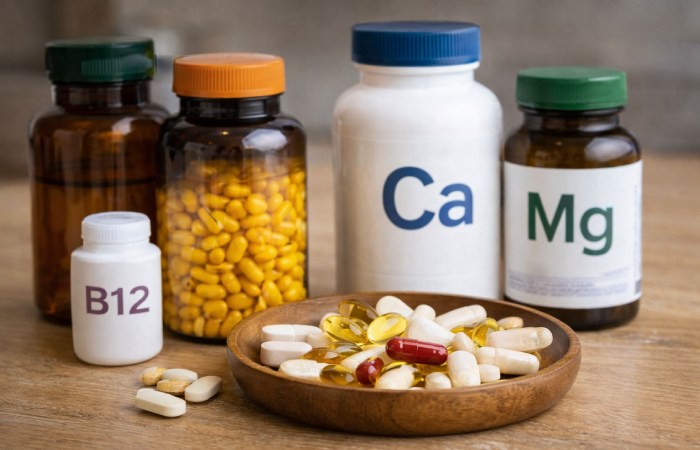
Vitamin D3 + K2 (MK-7): The Bone-Health Pair
Vitamin D3 supports calcium absorption in the gut — but here’s where it gets interesting. Without K2 (MK-7), the calcium you absorb may not reach your bones. K2 activates osteocalcin, a protein that binds calcium into bone tissue and keeps it out of arteries. These two work together.
Look for: D3 in the 1,000–2,000 IU range combined with K2 (MK-7) at about 45–90 mcg, unless your doctor advises otherwise. Avoid products that include D2 (ergocalciferol) — D3 (cholecalciferol) is more bioavailable and better studied.
Vitamin B12: The Energy and Brain Nutrient
B12 deficiency is common and often under-recognised in Indian adults — partly because symptoms (fatigue, brain fog, tingling in limbs) mimic general ageing, especially in women over 40. According to research published in the National Institutes of Health’s dietary supplement database, reduced stomach acid after 40 significantly impairs B12 absorption from food.
Look for: Methylcobalamin (the active, neurologically available form) rather than Cyanocobalamin. Typical supplemental doses range from 250–1,000 mcg, but the right dose depends on your blood levels.
A blood test before supplementing is always worthwhile.
Calcium: Right Form, Right Time
Calcium is non-negotiable for bone health — but the form matters. Calcium Citrate is better absorbed on an empty stomach and is gentler for women with sensitive digestion. Calcium Carbonate is cheaper but requires stomach acid to absorb (take with food).
Critical note: Never take Calcium and Iron at the same time. They compete for the same absorption pathway. Separate them by at least two hours.
Magnesium: The Nutrient Most Formulas Get Wrong
| Form | Absorption / Effectiveness | Best For | Common Issue |
|---|---|---|---|
| Magnesium Oxide | Very low absorption (often under 5%) | Budget cost | Causes digestive discomfort, laxative effect |
| Magnesium Citrate | Better absorbed than oxide | General use | Mild laxative if overdosed |
| Magnesium Bisglycinate | Well absorbed and gentle | Sleep, stress, anxiety | More expensive, but significantly better tolerated |
| Magnesium Malate | Well absorbed | Fatigue, muscle pain | Less common in Indian market |
Many budget Indian multivitamins use Magnesium Oxide — the cheapest and least effective form. If sleep quality and stress are concerns (they often are in perimenopause), Bisglycinate is worth the premium.
Folate (B9): Not Just for Pregnancy Anymore
After 40, folate’s role shifts from reproductive health to cardiovascular protection and DNA repair. Elevated homocysteine — a risk factor for heart disease — is managed partly by adequate folate intake.
Look for: Methylfolate (5-MTHF) rather than synthetic Folic Acid. Some women carry a genetic variation (MTHFR) that prevents them from converting Folic Acid into its active form — Methylfolate bypasses this issue entirely.
The Iron Question: Do Women Over 40 Still Need It?
This is one of the most important — and most ignored — questions in women’s supplement guides.
The short answer: it depends on where you are in your hormonal transition.
- Still menstruating heavily? You may still need iron supplementation to replace what’s lost monthly.
-
Periods becoming lighter or stopping (perimenopause/post-menopause)? In women who no longer menstruate, long-term unnecessary iron supplementation may contribute to iron overload (hemosiderosis), which is linked with oxidative stress and increased cardiovascular risk, so testing ferritin before adding iron is important.
What to do: Get a serum ferritin test before assuming you need iron. Many Indian women are deficient; many are not. A test costs less than a month’s worth of supplements.
If your multivitamin includes iron, check the dose. 8–18 mg is generally appropriate for pre-menopausal women. Iron-free formulations (like MegaFood Women’s 40+) are worth considering if you’re perimenopausal or post-menopausal.
Ayurvedic Boosters: Why Shatavari and Brahmi Matter
Several premium Indian multivitamins — particularly OZiva and Himalayan Organics — include adaptogenic herbs alongside standard vitamins. These aren’t just marketing additions. Here’s what the evidence suggests:
Shatavari (Asparagus racemosus) A well-documented Ayurvedic phytoestrogenic herb. Early research suggests it may help support hormonal balance during perimenopause, including mood stability and vasomotor symptoms, for some women. It’s not a replacement for medical treatment but is a reasonable complementary option.
Brahmi (Bacopa monnieri) Brahmi has been studied for its effects on cortisol regulation and cognitive function. For women experiencing brain fog or memory issues during perimenopause, Brahmi at an evidence-backed dose (150–300 mg standardised extract) may offer noticeable support for some women.
Ashwagandha (Withania somnifera) Cortisol rises during perimenopause, which depletes magnesium and disrupts sleep. Ashwagandha has been studied in multiple trials and may help reduce perceived stress and support the stress response. Look for KSM-66 or Sensoril standardised extracts.
Note: Ayurvedic herbs are categorised as food supplements under FSSAI regulations, not medicines. Therapeutic claims are regulated — be cautious of brands making medical-grade promises on packaging.
What to Look For on the Label (and What to Ignore)
Not all label claims are equal. Here’s a quick decision framework:
Green flags (worth paying for):
- Third-party tested (NABL-accredited lab, NSF, USP, or Informed-Sport certified)
- Methylated B vitamins (Methylcobalamin, Methylfolate)
- K2 in MK-7 form (not MK-4)
- FSSAI licensed manufacturer
- Magnesium as Bisglycinate or Malate
- Transparent dosing (exact mcg/mg per nutrient clearly stated)
Red flags (think twice):
- “Proprietary blend” with no individual dosages listed
- Magnesium Oxide as the primary magnesium source
- Folic Acid instead of Methylfolate in a “women 40+” product
- No third-party testing mentioned
- Extremely low price-per-serving (often signals under-dosed formulas)
Timing Protocol: When to Take What
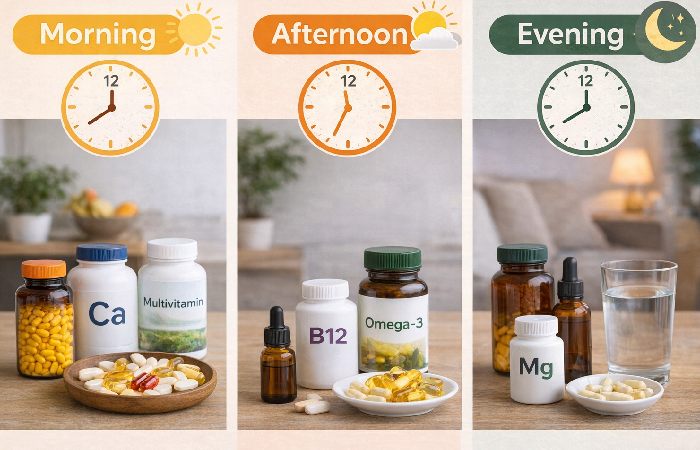
This is where most guides simply stop. But when you take certain nutrients matters — sometimes significantly.
| Nutrient | Best Timing | Why |
|---|---|---|
| Vitamin D3 | Morning or noon, with a fat-containing meal | Fat-soluble; better absorbed with dietary fat |
| K2 (MK-7) | With D3 (same meal) | Synergistic absorption |
| Calcium Citrate | Any time (even empty stomach) | Doesn’t require stomach acid |
| Calcium Carbonate | With food | Requires stomach acid to dissolve |
| Iron | On empty stomach, away from Calcium | Maximises absorption; Calcium blocks iron uptake |
| Magnesium Bisglycinate | Evening | Supports sleep, muscle relaxation |
| B12 (Methylcobalamin) | Morning | Supports energy metabolism from the start of the day |
| Omega-3 | With meals | Reduces fishy aftertaste; fat-soluble |
Split your multivitamin if it contains both Iron and Calcium — or choose a formula where these are separated into AM/PM packs (TrueBasics and some OZiva formats do this).
India Brand Snapshot: What’s Available and Who It’s Best For
This is not a product review — brand quality changes with formulation updates. But here’s a factual snapshot of the India-market landscape as of 2026, based on publicly available product information:
| Brand | Key Differentiator | Best For | Iron Status |
|---|---|---|---|
| OZiva Daily Women’s Multi | Shatavari, Brahmi, Arginine added | Hormonal balance, perimenopause | Contains Iron |
| Wellbeing Nutrition Multivitamin | Slow-release capsules, vegan omega-3 | Vegan women, absorption priority | Contains Iron |
| Earthful Women 40+ Calcium D3 K2 | Calcium + D3 + K2 MK-7 in one | Post-menopausal bone health | Iron-Free option |
| Himalayan Organics Multivitamin | Plant-based, Ayurvedic herbs | Budget-conscious, natural ingredient preference | Contains Iron |
| Centrum Women India | Widely available, Pfizer-backed | First-time supplement users | Contains Iron |
| TrueBasics Advanced Women | AM/PM split pack | Women who want Iron/Calcium separated | Split (Iron in AM, Calcium-separate) |
| MegaFood Women’s 40+ (via iHerb) | Third-party tested, whole-food form | Evidence-focused, premium buyers | Iron-Free |
Always verify current formulations directly with the brand before purchasing — ingredient lists change.
Common Mistakes Women Over 40 Make With Supplements
Here’s where it usually goes wrong.
- Taking a generic “women’s multivitamin” designed for 20–30 year olds. These are often higher in Iron and lower in K2 and B12 than women over 40 need.
- Ignoring Magnesium form. Picking a product because it contains Magnesium — without checking whether it’s the barely-absorbed Oxide form — is one of the most common supplement mistakes.
- Doubling up on Calcium. If your diet includes dairy, fortified foods, and a multivitamin — you may already be at or near the recommended 1,000–1,200 mg daily. Excess Calcium without K2 can accumulate in arteries.
- Taking everything at once. Iron and Calcium block each other’s absorption when taken together. Timing matters more than most people realise.
- Choosing price over bioavailability. A ₹199/month multivitamin using Magnesium Oxide and Cyanocobalamin delivers a fraction of the nutritional value of a better-formulated ₹600/month option.
Who This Guide Is For — and Who Should Seek Medical Advice First
This guide is ideal for:
- Women aged 38–55 navigating perimenopause or early menopause
- Women with fatigue, brain fog, or brittle nails they attribute to nutritional gaps
- Women who eat vegetarian or vegan diets (B12 and Omega-3 risk is higher)
- Those switching from a generic multivitamin to an age-specific formula
Speak to your doctor before supplementing if:
- You are on blood thinners or cardiac medications (Vitamin K2 interactions)
- You have haemochromatosis or a family history of iron overload
- You have kidney disease (Magnesium and Calcium supplementation requires monitoring)
- You are currently pregnant or planning to be (different requirements apply)
- You have diagnosed osteoporosis already under medical treatment
A serum Vitamin D test, ferritin test, and B12 test before starting any new supplement protocol is always the smartest first step.
Final Verdict: What Women Over 40 Actually Need
The perfect multivitamin for women over 40 doesn’t exist — because individual needs vary by cycle status, diet, and genetics. But the best formulas share common features.
The non-negotiables: D3 + K2 (MK-7), Methylcobalamin (B12), Calcium Citrate, Magnesium Bisglycinate, and Methylfolate. Everything else is a useful addition.
The iron question deserves a blood test, not an assumption.
Ayurvedic adaptogens (Shatavari, Brahmi) can be meaningful additions to a quality formula when dosed appropriately, but they should not replace medical treatment.
Timing matters. A well-chosen supplement taken at the wrong time — or alongside a nutrient that blocks its absorption — underperforms significantly.
For most women over 40, a quality multivitamin for women over 40 paired with a separate Magnesium Bisglycinate (taken at night) covers the majority of gaps without overspending. Get your levels tested first, then invest in a formula transparent enough to show you exactly what’s in each capsule.
Frequently Asked Questions
Q: Which multivitamin is best for a 45-year-old woman in India?
A: There is no single “best” — it depends on cycle status, diet, and specific deficiencies. That said, formulas combining D3, K2 (MK-7), Methylcobalamin B12, Calcium Citrate, and Magnesium Bisglycinate are consistently better matched to the physiological needs of women over 40 than generic women’s multivitamins. OZiva (for hormonal support), Earthful (for bone health), and TrueBasics Advanced (for split dosing) are well-regarded in the current India market.
Q: Can I take a multivitamin on an empty stomach?
A: It depends on the formula. Water-soluble vitamins (B-complex, Vitamin C) can generally be taken without food. Fat-soluble vitamins (D, K, E, A) require dietary fat to absorb properly — take them with a meal. If your multivitamin causes nausea on an empty stomach, always take it with food regardless.
Q: What are the signs of Vitamin B12 deficiency after 40?
A: Common signs include persistent fatigue, brain fog or memory issues, tingling or numbness in hands and feet, and a sore or inflamed tongue. These symptoms overlap with general perimenopause symptoms — a blood test (serum B12, ideally paired with MMA or homocysteine) is the only reliable way to confirm deficiency.
Q: Do women over 40 need iron in their multivitamin?
A: Not always. Pre-menopausal women who still have regular periods may need iron supplementation. Post-menopausal women or those with very light periods may be better served by an iron-free formula. Excess iron after menopause can accumulate and increase oxidative stress. Get a serum ferritin test — it costs less than one month of supplements.
Q: Is it safe to take an Ayurvedic multivitamin every day?
A: Generally yes, for healthy adults — provided the formula is FSSAI-licensed and contains herbs at evidence-backed doses. Shatavari and Brahmi at typical supplement doses are well-tolerated. However, women on thyroid medication should be cautious with Ashwagandha, and anyone on blood thinners should consult a doctor before taking adaptogens.
Q: What is the difference between Methylfolate and Folic Acid in a multivitamin?
A: Folic Acid is synthetic and must be converted by the body into its active form (5-MTHF). Some women — those with the common MTHFR gene variant — cannot make this conversion efficiently. Methylfolate bypasses this conversion and is directly usable by the body. For women over 40, Methylfolate is the preferable form, particularly for cardiovascular and cognitive health.
About Theglamourmedia
Theglamourmedia publishes practical, easy-to-understand content on health, technology, business, marketing, and lifestyle. Articles are based mainly on reputable, publicly available information, with AI tools used only to help research, organise, and explain topics more clearly so the focus stays on real‑world usefulness rather than jargon or unnecessary complexity.
Disclaimer:
This article is for general information only and is not a substitute for professional medical advice, diagnosis, or treatment. Nutrient and supplement needs vary from person to person based on health history, medications, blood work, and life stage. Always consult your doctor or a qualified healthcare provider before starting, changing, or stopping any multivitamin or supplement, especially if you have existing medical conditions or take prescription medicines.