

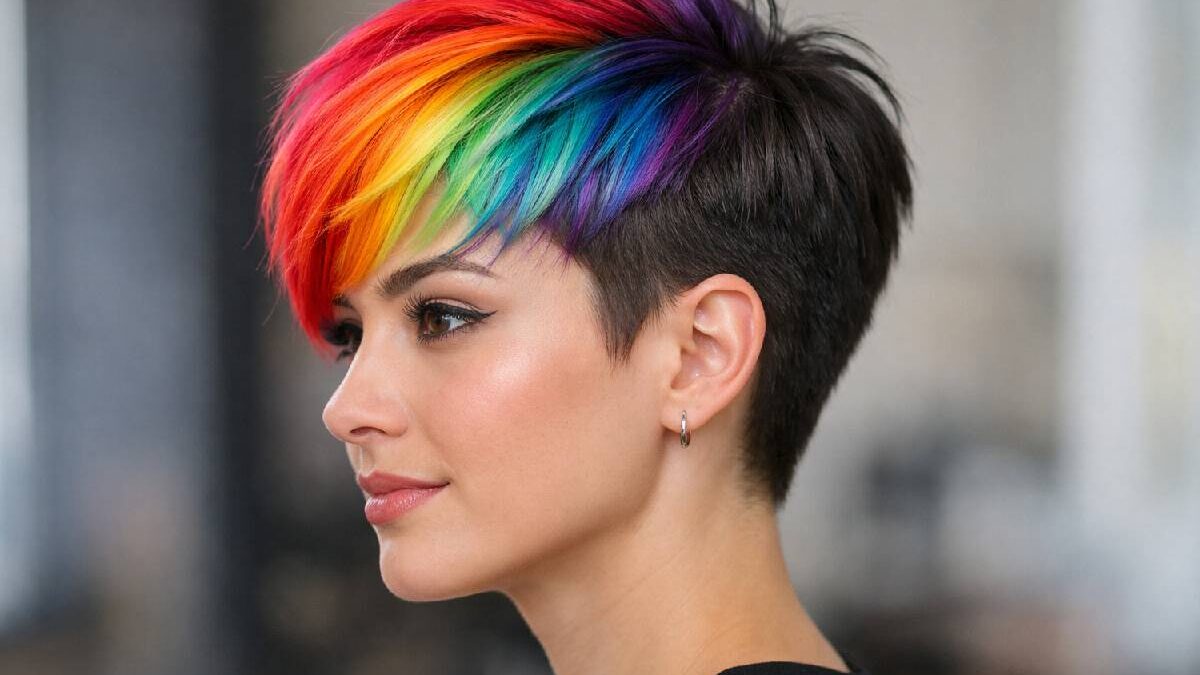
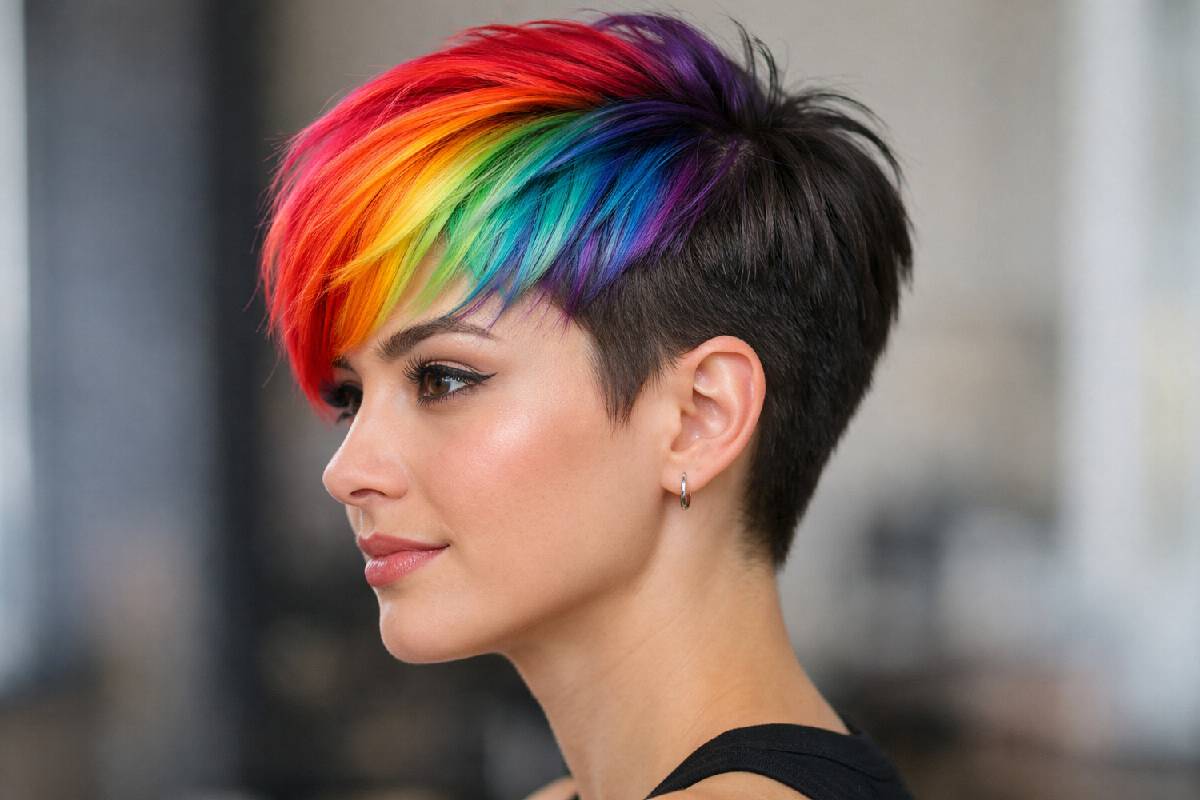
You want rainbow hair — but your cut is short, and the how-to guides you’ve found were built for waist-length waves. That’s the gap most beauty blogs leave wide open.
Short rainbow hair works beautifully — and in many ways, it works better on shorter cuts. Compact lengths let color saturation pop without visual noise, and techniques like hidden rainbow, color melting, and vivid balayage are all short-hair-friendly when applied correctly.
This guide covers the top styles trending in 2026, how to choose the right technique for your hair length and base color, a step-by-step color application overview, maintenance best practices, and a brand comparison table to help you pick the right dye.
Whether you’re working with a pixie, a French bob, or an undercut, there’s a rainbow approach here for you.
Table of Contents
Key Takeaways
- Want rainbow hair on a short cut? → Yes, it works — certain techniques are made for short lengths.
- Best style for dark hair? → Hidden rainbow (peekaboo) requires less bleach than full-head color.
- Most vibrant result? → Vivid balayage on a lightened base (Level 8–10).
- How long does it last? → Semi-permanent rainbow color usually stays vibrant for about 2–6 weeks, and with careful care can sometimes stretch closer to 8 weeks.
- Gentle, popular options? → Semi-permanent brands like Arctic Fox and Manic Panic are conditioning, vegan, and tend to fade out gradually rather than needing harsh removers.
What Is Short Rainbow Hair?
Short rainbow hair is a color technique — or combination of techniques — that places two or more vivid, contrasting hues across a short hairstyle (typically pixie cuts, bobs, undercuts, or shags). It works by sectioning the hair and applying individual colors in a deliberate sequence so the spectrum blends seamlessly at the transitions.
Unlike rainbow hair on long lengths, short rainbow hair prioritizes placement precision over gradient length. Each color zone is smaller, which means blending and sectioning skills matter more. Done well, the result is a vivid, wearable look with serious impact.
Top Short Rainbow Hair Styles for 2026
The landscape has shifted since the “unicorn hair” era of 2015–2018. Today’s short rainbow trends are more intentional, more personal, and — frankly — more interesting.
1. Hidden Rainbow Hair (Peekaboo)
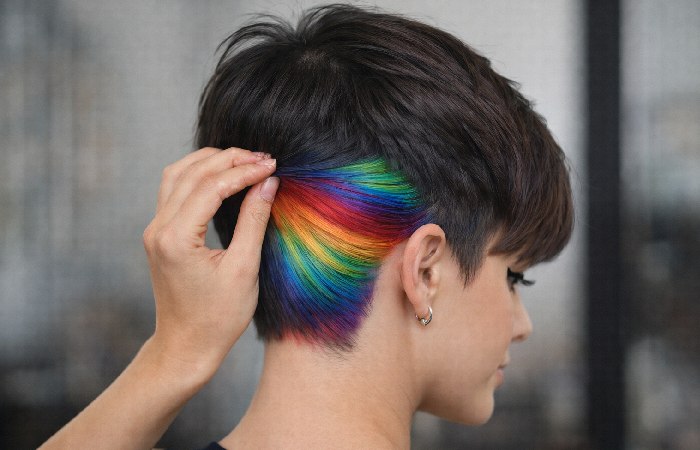
This is the most-requested technique for short hair right now, and for good reason.
Hidden rainbow hair places vivid color in the underlayer of the hair — the sections beneath the surface. When the hair lies flat, the colors are invisible. When you move, tuck hair behind your ear, or add texture, the spectrum reveals itself.
This works exceptionally well on pixie cuts and bobs with an undercut. It’s also the best choice if you want rainbow hair that can “switch off” for professional settings.
- Best for: Pixie cuts, undercuts, French bobs
- Base color: Works on dark hair with only partial bleaching (underlayer only)
- Commitment level: Low to medium
2. Pastel Rainbow Pixie
Soft, dreamy, and very 2026 — pastel rainbow on a pixie cut uses cotton-candy hues (lavender, baby blue, peach, mint) blended across all sections of the cut.
The result reads as “color” from a distance and “rainbow” up close. It suits fine hair well because the blended pastels don’t create heavy visual weight.
- Best for: Fine hair, pixie cuts, soft aesthetic
- Base required: Lightened to Level 9–10 (near platinum)
- Fade behavior: Pastels fade beautifully — they shift into muted, lived-in tones over 4–6 weeks
3. Vivid Full-Spectrum Bob
This is the maximalist option. All six spectrum colors — red, orange, yellow, green, blue, violet — distributed across a bob or lob, either in horizontal stripes (classic) or diagonal panels (more modern).
The key to making this work on a short cut is using the color melting technique at each transition zone. Hard lines between hues read as amateur; melted transitions read as professional.
- Best for: Bobs, lobs, statement looks
- Base required: Level 9–10 bleached
- Commitment: High — touching up 6 colors independently is time-intensive
4. Prism / Holographic Short Hair
One of the breakout 2026 trends. Prism hair uses silver or white as a base and layers iridescent, shifting tones — think oil-slick meets rainbow. On short cuts, the effect is architectural.
Brands like Arctic Fox’s “Transylvania” and “Poseidon” can be mixed to achieve prism-adjacent results. This technique thrives on structured cuts — sharp bobs, geometric pixies.
- Best for: Silver/white base hair, geometric cuts
- Commitment: High base prep, lower color maintenance
- 2026 appeal: Extremely high — dominates editorial and runway
5. 90s Grunge Rainbow Shag
The most interesting angle for 2026 is what stylists are calling the “imperfect rainbow” — a deliberate callback to the choppy, asymmetric dye jobs of the 1990s. Muted jewel tones (forest green, rust, cobalt, burgundy) applied to a layered shag without seamless blending.
It’s not sloppy — the “mess” is intentional. Think Courtney Love, not Lisa Frank.
- Best for: Shags, layered cuts, alternative aesthetic
- Base: Works on lightly lifted or naturally medium-brown hair
- Dye choice: Pulp Riot’s muted tones suit this look better than neons
Short Rainbow Hair by Cut Type: Quick Reference Table
| Cut Type | Best Technique | Color Palette | Bleach Required? |
|---|---|---|---|
| Pixie (classic) | Pastel balayage | Cotton candy pastels | Yes (full) |
| Pixie (undercut) | Hidden rainbow | Any vivid palette | Partial only |
| French Bob | Color melt / vivid balayage | Jewel tones or neon | Yes (full) |
| Shag / Layers | 90s grunge rainbow | Muted jewel tones | Optional |
| Buzz Cut | Micro-rainbow tips | Neon or prism | Yes (full) |
| Lob (long bob) | Full-spectrum stripe | Classic ROYGBIV | Yes (full) |
How to Do Short Rainbow Hair: Step-by-Step Overview
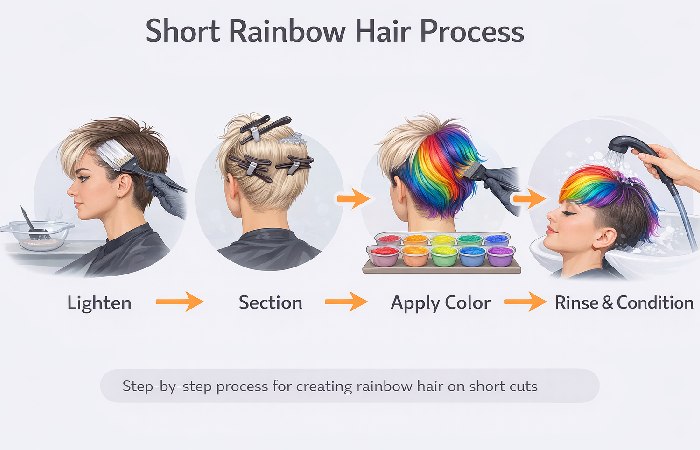
This is a simplified process guide. For complex techniques (full vivid balayage, prism), a professional colorist is strongly recommended — especially for dark starting hair.
Step 1: Assess Your Starting Base
- Natural hair at Level 4 or darker needs to be lightened to at least Level 8 before vivid color will show.
- Hidden rainbow is the exception — only the underlayer needs lifting.
- Do a strand test before committing to a full bleach session.
Step 2: Lighten the Hair
- Use a 20-volume developer for fine or already-processed hair.
- Use 30-volume for virgin dark hair.
- Apply a bond protector — Olaplex No. 1 Bond Multiplier is the industry standard for minimizing bleach damage during lifting.
- Process to Level 9–10 for vivid results; Level 8 is sufficient for jewel tones.
Step 3: Section and Map Your Colors
- Divide the hair into 4–6 sections depending on how many colors you’re using.
- Work from front to back, or bottom to top (for hidden rainbow).
- Use foils or clips to keep sections separate while colors process.
Step 4: Apply Colors in Sequence
- Apply the lightest color (yellow, light pink) first to avoid cross-contamination.
- Work one section at a time.
- At each transition zone, use a tint brush to feather the edge of each color into the next for a melted rather than hard-line effect.
- Process according to dye brand instructions (semi-permanent dyes typically need 20–45 minutes).
Step 5: Rinse and Condition
- Rinse each color separately if possible, starting with the lightest section.
- Use cool
water only** — hot water opens the hair cuticle and forces pigment out.**
- Apply a deep conditioning mask immediately post-rinse. After heavy bleaching, K18 Leave-In Molecular Repair Treatment is particularly effective.
Rainbow Hair Dye Brands: Side-by-Side Comparison
Choosing the right dye brand changes both the process and the outcome. Here’s how the main options compare.
| Brand | Type | Longevity | Fade Pattern | Best For | Conditioning? |
|---|---|---|---|---|---|
| Arctic Fox | Semi-permanent | 2–6 weeks | Fades to pastel | Vivid & pastel | Yes (vegan) |
| Manic Panic | Semi-permanent | 4–6 weeks | Fades unevenly | Classic rainbow | Moderate |
| Pulp Riot | Professional semi-perm | 6–10 weeks | Fades evenly | Jewel tones, salon use | Yes |
| Pravana Vivids | Professional permanent | 8–12 weeks | Requires color remover | Long-wear vivid | Moderate |
| Ion Color Brilliance | Semi-permanent | 3–5 weeks | Fast fade | Budget-friendly DIY | Low |
The practical takeaway: For at-home short rainbow hair, Arctic Fox is one of the most forgiving options — it is conditioning, fades into softer tones rather than muddy ones, and does not require a developer.
How to Maintain Short Rainbow Hair (And Make It Last Longer)
Color on short hair fades faster than on long hair for one reason: the more you wash, the more pigment you lose. Short hair is also styled more frequently, which means more heat exposure.
Here’s how to keep the vibrancy as long as possible:
Washing habits
- Wash no more than 2–3 times per week.
- Always use cool or cold water.
- Use a sulfate-free, color-safe shampoo. According to Wella Professional’s color care guidance, sulfate-containing shampoos are among the leading causes of accelerated color fade in vivid-dyed hair.
Heat protection
- Apply a heat protectant before any blow-dry, flat iron, or curling tool use.
- Lower heat settings (below 350°F / 175°C) cause significantly less cuticle damage.
Color refreshing
- Mix a small amount of your dye into a white or clear conditioner to create a tinted co-wash. Apply weekly between full dye sessions to boost vibrancy without committing to a full re-dye.
UV protection
- UV rays degrade vivid pigments quickly. Apply a UV-protectant hair spray or wear a hat in direct sun during summer months.
Deep conditioning
- Rainbow-dyed hair — especially on bleached lengths — needs moisture. Weekly deep conditioning treatments prevent brittleness, which causes color to lift unevenly during fading.
Common Mistakes to Avoid with Short Rainbow Hair
These are the errors that lead to muddy, damaged, or short-lived results. Most are fixable before they happen.
- Skipping the strand test. Every head of hair responds differently to bleach and vivid dye. A strand test on a small hidden section takes 30 minutes and saves you from a full-head disaster.
- Mixing warm and cool tones carelessly. Red next to green creates brown at the transition. Map your color wheel before starting — complementary colors need a white or silver buffer section between them.
- Using hot water to rinse. This is one of the top causes of rapid fade. Cool water keeps the cuticle closed and the pigment sealed in.
- Over-bleaching fine hair. Fine hair reaches Level 10 faster than coarse hair and is more prone to breakage if left in developer too long. Watch the lift carefully.
- Applying dark tones over light tones. Layer your colors by value. Apply lighter hues first, darker last. Reversing this muddies the palette.
- Skipping bond protection during bleach. Products like Olaplex No. 1 or K18 Peptide Prep Pro Clarifying Detox Shampoo significantly reduce the structural damage bleach causes to fine, short strands.
Who Short Rainbow Hair Is For (And Who Should Proceed Carefully)
Best for:
- People with healthy, not-recently-chemically-treated hair
- Those comfortable with a 2–6 week color refresh cycle
- Anyone with an undercut or pixie wanting a low-commitment color pop (hidden rainbow)
- Dark-haired individuals willing to partially lift underlayers only
Proceed carefully if:
- Your hair is chemically relaxed, permed, or heavily heat-damaged — bleach on already-compromised hair increases breakage risk significantly
- You need a fully “off” look for work — full vivid rainbow is hard to conceal; hidden rainbow is the better option
- You have very fine or thin hair — full bleach lifts carry higher breakage risk; consult a colorist before committing
Not recommended if:
- Your hair has active scalp conditions (psoriasis, open wounds, active dermatitis) — bleach and vivid dyes can aggravate these
- You recently bleached within the last 2–3 weeks — the hair needs a structural recovery window
Final Verdict: Is Short Rainbow Hair Worth It?
Short rainbow hair is one of the most rewarding color commitments you can make — if you go in with the right expectations.
The work is real: bleaching, precise sectioning, regular maintenance, and a color refresh every 2–6 weeks. But the payoff — a truly custom, wearable spectrum of color on a precision cut — is something no filter can replicate.
For most people starting out, hidden rainbow on a pixie or undercut is the smartest entry point. It minimizes bleach exposure, works on dark hair, and gives you a preview of how vivid color behaves on your specific hair texture before you go full-spectrum.
If you’re already on a lightened base, pastel rainbow balayage on a bob is the 2026 trend most likely to stay beautiful through its fade cycle — and that matters when you’re investing the time and effort.
Frequently Asked Questions
Q: Can you get short rainbow hair without bleaching?
A: On naturally light or already-lightened hair (Level 7 and above), vivid semi-permanent colors can show without bleaching. On dark hair (Level 4 and below), bleach is necessary for the colors to appear true to tone. The exception is hidden rainbow — only the underlayers need lifting, which significantly reduces overall bleach exposure.
Q: How long does short rainbow hair last?
A: Semi-permanent rainbow hair usually stays vibrant for about 2–6 weeks before noticeable fading, depending on wash frequency, water temperature, and aftercare. Professional vivid lines like Pulp Riot and Pravana Vivids often hold toward the upper end of that range, and with gentle care can sometimes last beyond it compared to many DIY semi‑permanent options.
Q: Is rainbow hair harder to maintain on short hair vs. long hair?
A: In some ways, yes. Short hair is washed and styled more frequently per inch, which accelerates fading. But short hair also uses less product per refresh, making touch-ups faster and less expensive. The maintenance schedule is similar — 2–6 weeks — but shorter lengths make the process quicker each time.
Q: What’s the best rainbow hair style for a professional environment?
A: Hidden rainbow (peekaboo) is the most workplace-friendly option. Colors are placed in the underlayer and only visible when you move your hair. When worn down and styled smoothly, the look reads as natural color. Many people use this technique specifically to bridge personal expression with professional settings.
Q: How do I stop my rainbow hair from fading so fast?
A: The most impactful changes are: wash with cold water, switch to a sulfate-free shampoo, reduce wash frequency to 2–3 times per week, and add a tinted conditioner (a small amount of dye mixed into conditioner) between full dye sessions. UV exposure is also a major fade accelerator — UV-protectant hair spray helps in summer.
Q: Can men get short rainbow hair?
A: Absolutely. Techniques like hidden rainbow under an undercut, vivid tips on a buzz cut, and prism-toned sides on a fade all work well on masculine short cuts. Some of the most technically interesting short rainbow hair content currently comes from men’s barbering and queer-focused salon spaces.
About Theglamourmedia
Theglamourmedia.com publishes practical, easy-to-understand content on health, technology, business, marketing, and lifestyle. Articles are based mainly on reputable, publicly available information, with AI tools used only to help research, organise, and explain topics more clearly so the focus stays on real‑world usefulness rather than jargon or unnecessary complexity.
Disclaimer
Recommendations in this article apply primarily to short and medium-length hair. For significantly longer hair, consult a professional, as product usage, processing time, and results can differ.